What if
You're Missing
Half the Story?
Immunodeficient mouse models give you consistent data.
But they’re missing the human immune system, one of the primary drivers of clinical response.
Does the human immune system change
YOUR compound's story?
Find out with the Immune Engagement Study Package.
A ready-to-run study that reveals how the human immune system influences your compound’s therapeutic response. The standardized design compares immunodeficient FcResolv® NOG with FcResolv® huNOG humanized through CD34+ HSC engraftment, with vehicle and treatment groups run side-by-side.
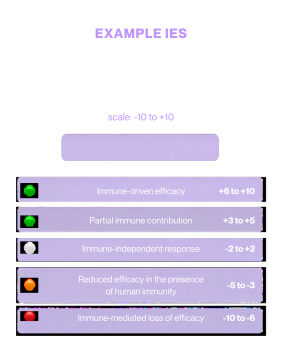
The study translates complex immune biology into TransCure’s proprietary Immune Engagement Score (IES), an actionable measure of the human immune contribution to therapeutic response, helping you reduce uncertainty, define the right development strategy, and accelerate promising therapies toward patients.
-
One Study
Two immune contexts.
One direct comparison.Reveal how the human immune system influences your compound’s therapeutic response
-
8 Weeks
From study start
to final report.Decision-ready efficacy and immune engagement data without adding months to your development program
-
€15,000
$17,500
One package.
Everything included.Four study groups, efficacy assessment, immune profiling, Immune Engagement Score (IES), comprehensive report, and scientific interpretation, all included.
-
Informed Strategy
One score.
One actionable answer.The Immune Engagement Score (IES) reveals whether human immunity enhances, limits, or has minimal impact on therapeutic response helping you make faster, more informed decisions.
Study Design
-
Group 1 (n=5 mice)
Tumor growth. No compound, no human immune system
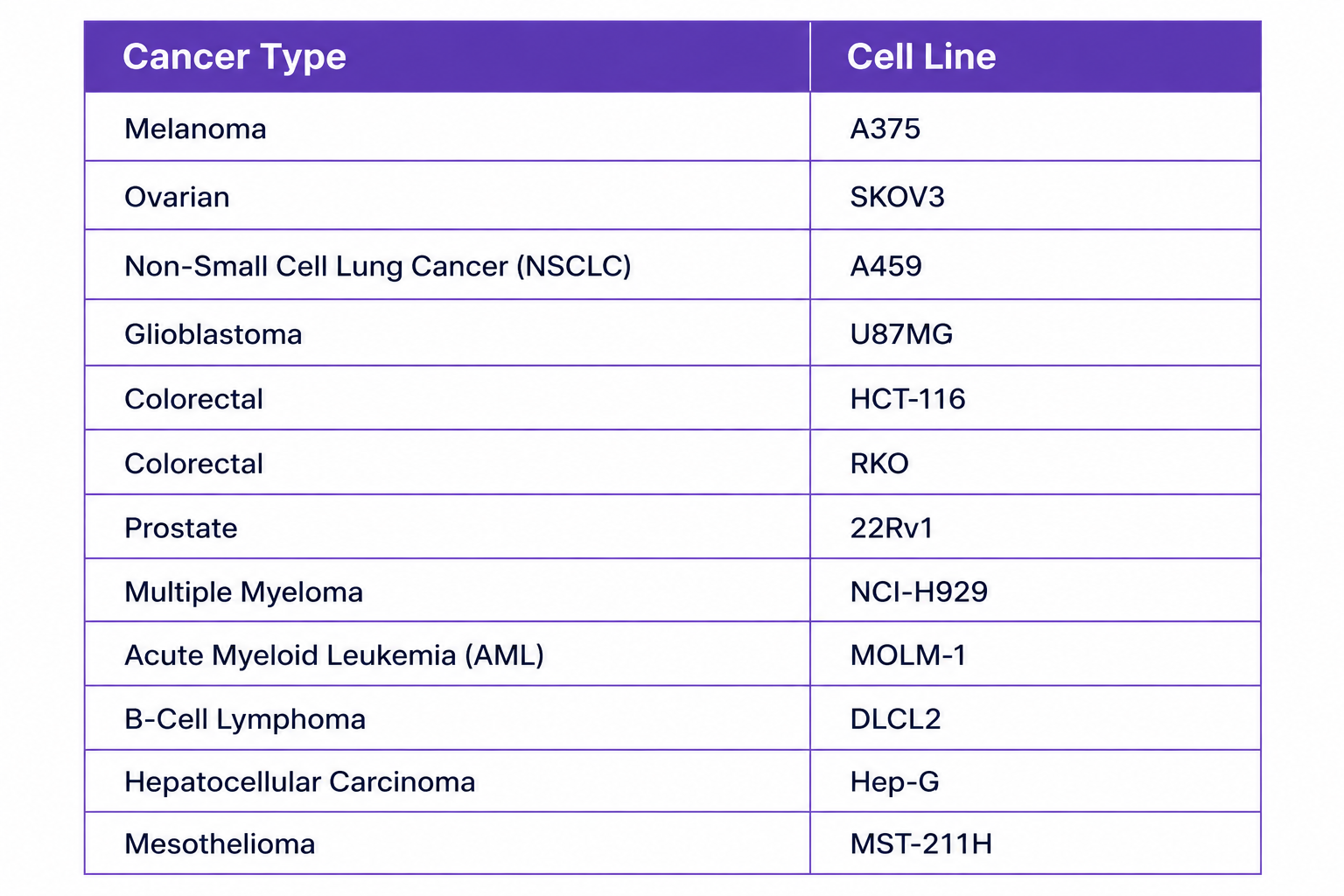
Immunodeficient mice FcResolv® NOG CDX engraftment (choose from the list) Vehicle -
Group 2 (n=5 mice)
Anti-tumor effect. No human immune system
Immunodeficient mice FcResolv® NOG CDX engraftment (choose from the list) YOUR compound -
Group 3 (n=5 mice)
Human immune impact on tumor growth. No compound
Humanized Immune System mice FcResolv® huNOG CDX engraftment (choose from the list) Vehicle -
Group 4 (n=5 mice)
Compound meets human immunity. The full picture
Humanized Immune System mice FcResolv® huNOG CDX engraftment (choose from the list) YOUR compound
Readouts
-
📈 Tumor Volume Measurement
-
🔬 Immune Cell Infiltration
-
📄 Immune Engagement Score (IES)
Same drug.
Two immune contexts.
Two different stories.
Across published studies, one message has emerged repeatedly: the human immune system is not just another variable, it can fundamentally alter therapeutic response. Immunodeficient mouse models miss human immune-driven mechanisms that influence efficacy, resistance, and mechanism of action.
The example below illustrates this principle. In a 2024 peer-reviewed study (De Wispelaere et al., Clinical and Translational Medicine), the same PI3K/mTOR inhibitor combination (alpelisib + sapanisertib) was evaluated in immunodeficient nude mice and in CD34+ humanized mice reconstituted with a human immune system.
Adding the human immune system revealed an immune-dependent therapeutic response that was invisible in immunodeficient models.
-
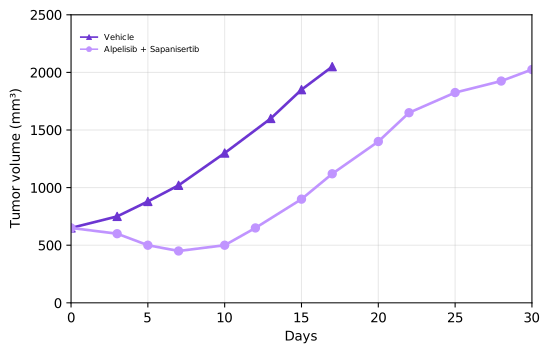
Immunodeficient Mouse Model
EMC041 PDX
Drug initially suppresses tumor, but resistance sets in from Day 7. Tumor escapes and regrows to vehicle levels by Day 30.
Incomplete picture.
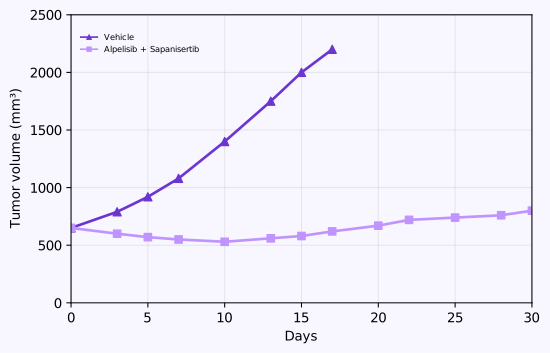
Humanized Immune System Mouse Model
EMC041 PDX
Same drug. Same tumor. Sustained suppression maintained through Day 30. The difference? A functional human immune system that engaged with the treatment.
The full story.
Every study delivers an
Immune Engagement Score (IES)
IES = Tumor Growth Inhibition (TGI) Score + Tumor Infiltration Score
-
TGI Score
Did the human immune system change efficacy?Compares tumor growth inhibition between the humanized arm (Group 4) and the immunodeficient arm (Group 2). The difference tells you whether the human immune system amplified, neutralized, or counteracted your drug's effect. Scored on a −5 to +5 scale. -
Tumor Infiltration Score
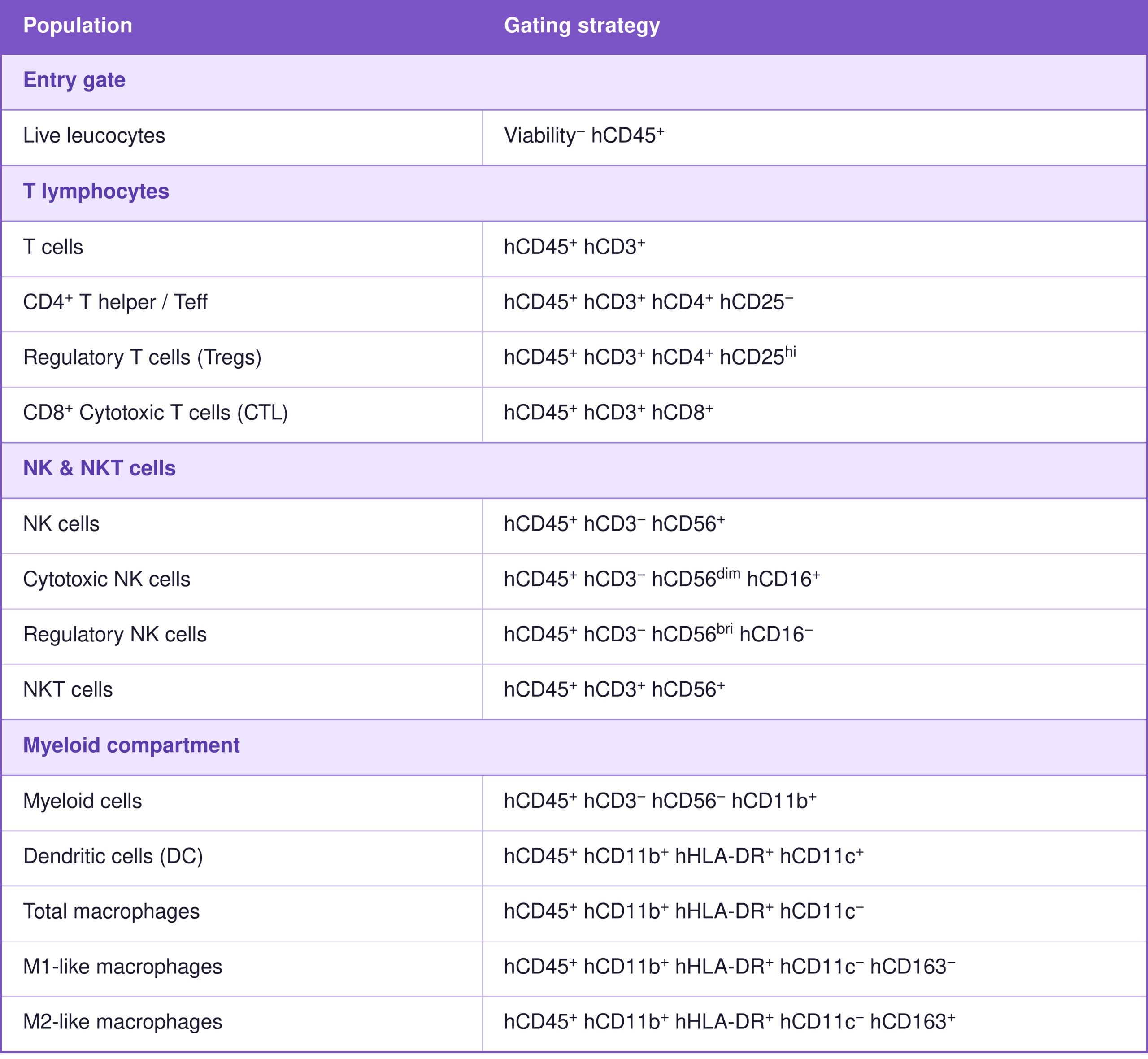
Did the human immune system engage?Four immune cell metrics measured in the humanized arms: T-cell cytotoxicity (CTL vs Treg), macrophage polarization (M1 vs M2), NK cell activation, and overall myeloid activation. Together they confirm whether the immune system was an active participant, or a bystander. Scored on a −5 to +5 scale. -
IES = TGI Score + Tumor Infiltration Score
(range: −10 to +10)Delivered as a report with TGI curves, immune cell data, score breakdown, and a clear strategic recommendation.
Connect with Our Scientists
Connect with our scientific team to determine whether the human immune system is influencing your therapy, and how the Immune Engagement Score (IES) can provide the answer.
"*" indicates required fields